

Plus de 30 échauffements de chorale : Le guide complet pour les chefs de chœur
Plus de 30 exercices d'échauffement de chorale pour chaque répétition. Échauffements physiques, exercices de respiration, techniques vocales et activités de groupe amusantes. Un guide complet de l'équipe derrière ChoirMate.
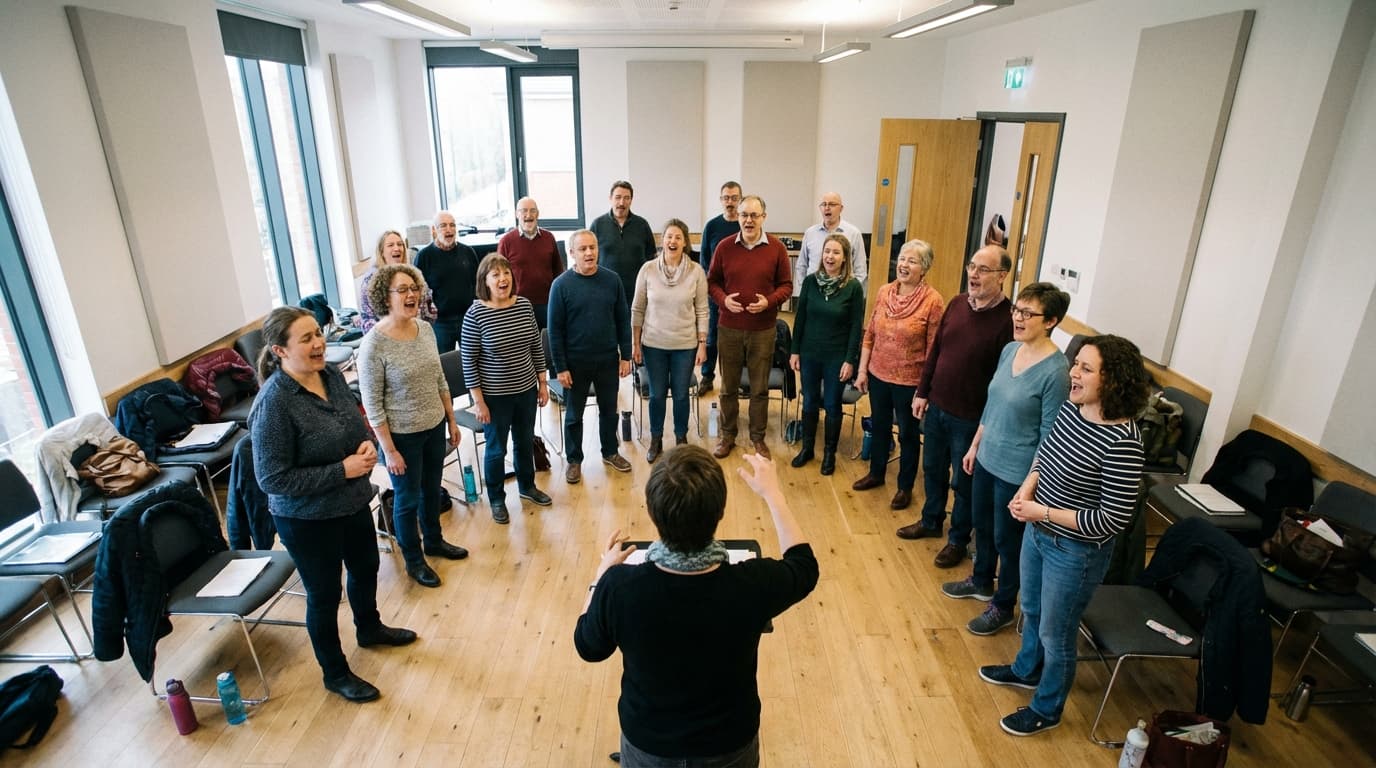
Les meilleurs échauffements de chorale combinent des étirements physiques, des exercices de respiration et des techniques vocales pour préparer les chanteurs à la répétition. Une routine de 10 à 15 minutes commence généralement par la relaxation corporelle (roulements de cou, haussements d'épaules), passe au soutien respiratoire (respiration diaphragmatique, trilles labiales) et se termine par des exercices vocaux (gammes, arpèges, canons). Ce guide couvre plus de 30 exercices utilisés par les chefs de chœur du monde entier.
Tout chef de chœur expérimenté connaît la différence entre une répétition qui commence à froid et une qui commence par un échauffement approprié. Dans le premier cas, vous passez les vingt premières minutes à faire sortir du son d'une pièce pleine de corps tendus et de voix endormies. Dans le second, vous démarrez sur les chapeaux de roue : le groupe est présent, le son est centré, et tout le monde se sent comme une chorale plutôt que comme une collection d'individus.
Les échauffements ne servent pas seulement à protéger les voix de la fatigue (bien que cela compte aussi). Ils signalent le début de la répétition, renforcent la cohésion du groupe, établissent le son de l'ensemble et vous donnent quelques minutes pour évaluer l'état du groupe aujourd'hui, qu'il soit énergique ou fatigué, concentré ou dispersé. Une bonne routine d'échauffement est l'un des outils les plus précieux dans la trousse d'un chef.
Dans ce guide, j'ai rassemblé plus de 30 exercices répartis en cinq catégories : physique, respiration, vocal débutant, vocal avancé et activités de groupe. Chacun est pratique et testé lors de répétitions réelles. Si vous utilisez ChoirMate pour gérer vos répétitions, vous pouvez enregistrer vos séquences d'échauffement préférées sous forme de listes de pratique afin que vos chanteurs puissent les revoir entre les sessions également.
1. Échauffements physiques
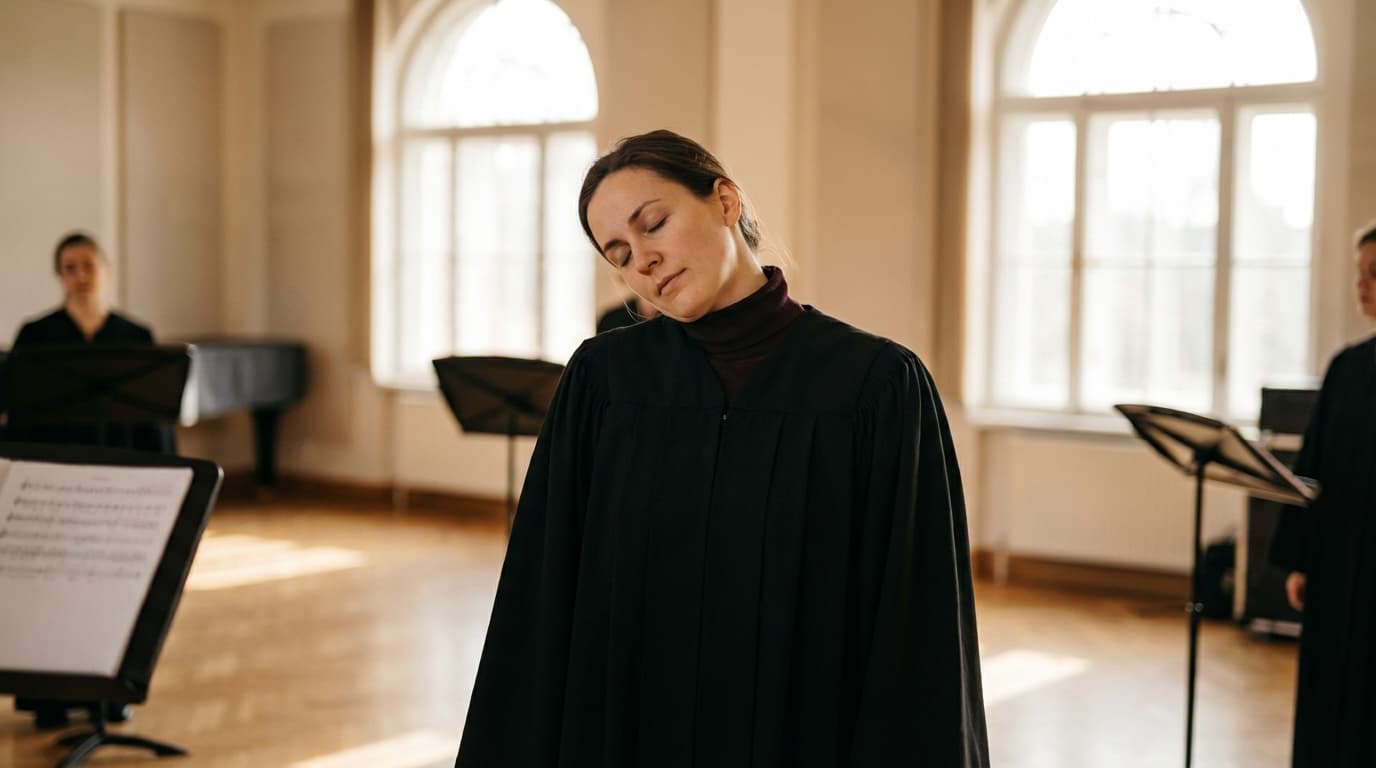
Chanter est une activité qui engage tout le corps. La tension dans le cou, les épaules ou la mâchoire se manifestera directement dans votre son. Avant de produire un seul son musical, détendez le corps et adoptez la bonne posture.
Roulements de cou
Laissez tomber le menton vers la poitrine lentement, puis roulez la tête d'un côté, remontez par le centre, et de l'autre côté. Évitez de rouler la tête complètement en arrière. Gardez-la dans un doux demi-cercle. Deux ou trois roulements lents dans chaque direction suffisent à relâcher la tension dans les muscles du cou qui affectent directement le larynx.
Haussements et roulements d'épaules
Levez les deux épaules vers les oreilles en inspirant, maintenez un instant, puis relâchez-les complètement en expirant. Suivez cela par des cercles d'épaules vers l'arrière, en ramenant les épaules vers le haut, l'arrière, le bas et l'avant dans une rotation lente. Cela ouvre la poitrine et libère la tension que les chanteurs retiennent souvent dans le haut du dos.
Étirements de la mâchoire
Ouvrez la bouche aussi largement que confortable et maintenez pendant trois secondes, puis relâchez. Suivez par de légers mouvements de la mâchoire de gauche à droite. De nombreux chanteurs portent une quantité surprenante de tension dans la mâchoire et les muscles masséters. Relâcher cela avant de chanter aide les voyelles à s'ouvrir et le son à devenir plus résonant.
Étirements de la cage thoracique
Tenez-vous debout, pieds écartés à la largeur des épaules, levez les deux bras au-dessus de la tête et penchez-vous lentement d'un côté, en étirant la cage thoracique. Maintenez quelques secondes, revenez au centre et répétez de l'autre côté. Les chanteurs ont besoin de muscles intercostaux flexibles pour expandre pleinement les poumons, et cet étirement les prépare.
Alignement postural
Demandez aux chanteurs de se tenir debout, pieds écartés à la largeur des hanches, genoux souples (non bloqués), colonne vertébrale droite, et épaules détendues et légèrement en arrière. Le sommet de la tête doit donner l'impression d'être doucement soulevé vers le plafond. Demandez-leur de basculer vers l'avant sur la pointe des pieds et vers l'arrière sur les talons quelques fois pour trouver une position équilibrée et ancrée. Une bonne posture n'est pas rigide. Elle est énergique et libre.
Rebondissements doux
Rebondissez simplement légèrement sur la pointe des pieds pendant 20 à 30 secondes, en laissant le corps se détendre. C'est particulièrement utile au début d'une répétition lorsque les chanteurs viennent d'arriver de l'extérieur ou ont été assis toute la journée. Cela libère la tension résiduelle et apporte un sentiment de jeu physique dans la pièce, créant la bonne ambiance pour tout ce qui suit.
2. Exercices de respiration
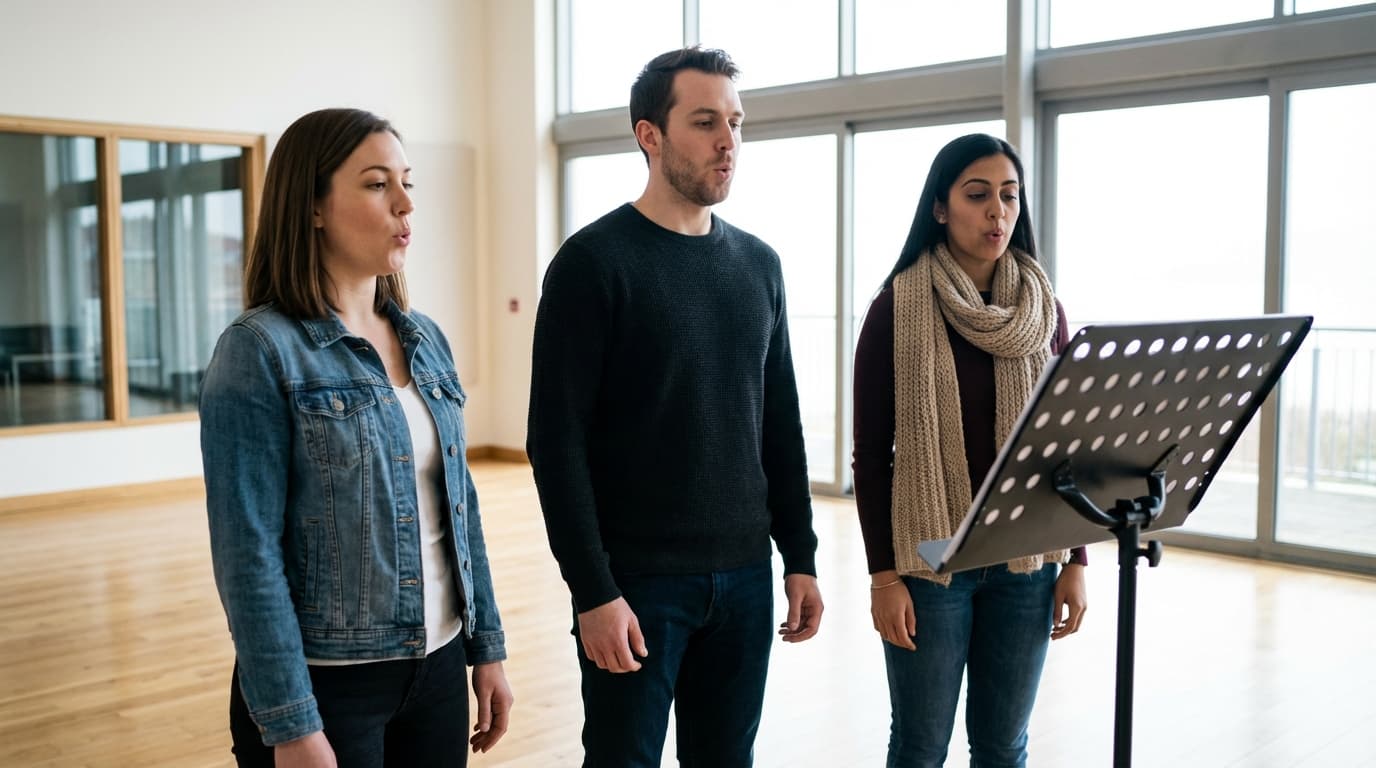
Le souffle est le moteur du chant. Ces exercices développent le contrôle diaphragmatique, la capacité respiratoire et le type de flux d'air soutenu et régulier dont dépend une bonne sonorité chorale.
Respiration diaphragmatique
Demandez aux chanteurs de placer une main sur la poitrine et une sur le ventre. Inspirez lentement par le nez pendant quatre temps, en visant à expandre le ventre (pas la poitrine) vers l'extérieur. Expirez pendant quatre temps. Le but est de sentir la main inférieure bouger plus que la supérieure. Une fois que le groupe a la sensation, essayez d'inspirer pendant quatre et d'expirer pendant huit, établissant le contrôle dont ils auront besoin pour les longues phrases.
L'exercice du sifflement
Prenez une pleine inspiration, puis expirez sur un son "sss" soutenu. Le but est de rendre le sifflement aussi régulier et contrôlé que possible, le plus longtemps possible, plutôt que d'expulser tout l'air d'un coup. Cela développe la conscience de la gestion du souffle et aide les chanteurs à comprendre ce que l'on ressent avec un "soutien contrôlé". Visez 10 à 15 secondes pour commencer, en travaillant vers 20+.
Respiration staccato
Prenez une inspiration, puis expirez par de courtes et vives rafales sur "ch" ou "ts", huit impulsions rapides par respiration. Cela active le diaphragme de manière directe et physique et aide les chanteurs à ressentir l'engagement du tronc nécessaire pour un chant soutenu. Cela réveille également le groupe rapidement, ce qui en fait une excellente ouverture lorsque l'énergie est faible.
Comptage du contrôle respiratoire
Inspirez pendant quatre temps, puis expirez en comptant à voix haute aussi lentement que possible. Le but est de voir qui peut atteindre le nombre le plus élevé avant de manquer de souffle. Transformer cela en une compétition amicale donne aux chanteurs un retour immédiat sur leur capacité respiratoire et leur apprend à gérer le flux d'air sur une longue phrase.
Trilles labiales
Soufflez de l'air à travers des lèvres lâchement fermées afin qu'elles vibrent en trille (comme un bateau à moteur). Maintenez la trille sur une hauteur, puis glissez vers le haut et vers le bas. Les trilles labiales sont brillantes car elles détendent les lèvres, engagent le souffle et engagent doucement les cordes vocales, tout à la fois. Si les chanteurs ont du mal, demandez-leur de presser légèrement les joues vers l'intérieur avec le bout des doigts.
Expiration lente avec résistance
Inspirez complètement, puis expirez par une petite forme de "o" dans les lèvres, comme si vous souffliez dans une fine paille. La résistance crée une contre-pression et entraîne le chanteur à soutenir la colonne d'air plutôt que de la laisser s'effondrer. C'est aussi une technique de thérapie vocale bien connue pour s'échauffer sans exercer de tension directe sur les cordes vocales.
3. Échauffements vocaux pour débutants
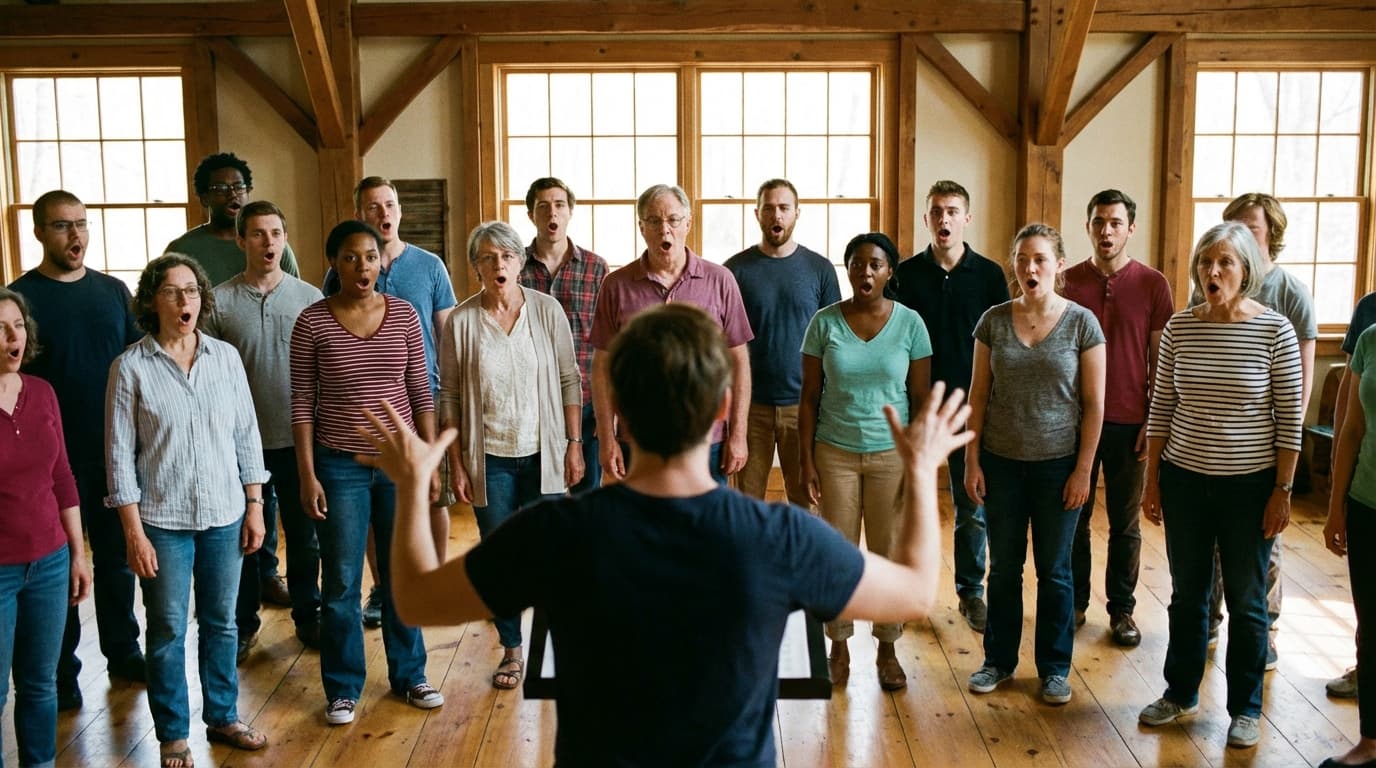
Ces exercices sont accessibles aux chanteurs de tous niveaux, mais sont particulièrement adaptés aux chorales communautaires, aux chorales de jeunes ou à toute personne nouvelle aux échauffements structurés. Ils introduisent des concepts fondamentaux comme la résonance, l'étendue et la formation des voyelles, sans submerger les chanteurs de demandes techniques.
Fredonnement
Commencez sur une hauteur moyenne confortable et fredonnez avec les lèvres doucement fermées, en sentant la vibration dans les lèvres, les joues et le nez. Glissez lentement de quelques pas vers le haut et vers le bas. Le fredonnement est l'une des manières les plus douces d'engager la voix : il place le son vers l'avant, échauffe progressivement les cordes vocales et donne aux chanteurs un sens immédiat de la résonance sans aucune pression de formation des voyelles.
Sirènes
Sur un son neutre "ng" ou "wee", glissez continuellement du bas de la voix vers le haut et vers le bas, comme une sirène. Le but est un glissement doux sans interruption. Les sirènes sont excellentes pour relier la rupture de registre entre la voix de poitrine et la voix de tête, encourageant la voix à se mélanger sur toute son étendue plutôt que de changer brusquement.
Gammes de cinq notes
Chantez "do-ré-mi-fa-sol-fa-mi-ré-do" sur un son de voyelle (essayez "ah" ou "oh"), en montant d'un demi-ton à chaque répétition. Commencez suffisamment bas pour que tout le monde soit à l'aise, et continuez seulement jusqu'à ce que la voix commence à se sentir tendue. C'est l'un des exercices vocaux les plus efficaces car il couvre l'étendue, l'uniformité des voyelles et la justesse de la hauteur tout à la fois.
Formes de voyelles
Chantez une note soutenue sur chacune des cinq voyelles pures en séquence : "ah – eh – ee – oh – oo." Concentrez-vous sur le maintien de la mâchoire relâchée sur "ah", en évitant un son étalé sur "ee", et en gardant "oo" vers l'avant plutôt qu'avalé. Des formes de voyelles cohérentes sont l'un des facteurs les plus importants pour un son choral unifié, donc y consacrer du temps est toujours utile.
Glissandos d'octave
En partant d'une hauteur basse, chantez une voyelle soutenue et glissez doucement d'une octave vers le haut, maintenez brièvement en haut, puis glissez vers le bas. Encouragez les chanteurs à garder la mâchoire détendue en haut et à résister à l'instinct de pousser plus fort à mesure que la hauteur monte. Cela développe la conscience de l'étendue et renforce l'idée que les notes aiguës nécessitent moins de tension, pas plus.
4. Échauffements vocaux avancés
Pour les chorales plus expérimentées, ces exercices affinent la technique, étendent l'étendue, développent le contrôle dynamique et l'agilité vocale nécessaire pour un répertoire exigeant.
Arpèges
Chantez un arpège majeur (fondamentale, tierce, quinte, octave, quinte, tierce, fondamentale) sur une seule voyelle, en montant par demi-tons à chaque répétition. Les arpèges exigent une plus grande précision d'intervalle que les gammes et mettent les chanteurs au défi de maintenir une couleur de son constante sur une plus grande étendue. Essayez-les sur différentes voyelles pour exposer où la voix change de caractère.
Virelangues
Des classiques comme "Les chaussettes de l'archiduchesse, sont-elles sèches, archi-sèches ?" ou "Un chasseur sachant chasser doit savoir chasser sans son chien" chantés sur des notes répétées ou une mélodie simple affinent l'articulation et réveillent la langue, les lèvres et le palais. Pour l'usage choral, les virelangues sont particulièrement utiles avant un répertoire avec un texte exigeant : ils mettent les articulateurs en marche avec précision au tempo et ont tendance à générer un peu de rire, ce qui détend le groupe.
Contrastes dynamiques
Maintenez une hauteur ou chantez une phrase d'abord en pianissimo, puis en mezzo forte, puis en fortissimo, et redescendez. Le but n'est pas seulement de chanter plus fort, mais de maintenir une qualité de son et une résonance constantes sur toute la plage dynamique. C'est une excellente préparation avant de répéter tout répertoire avec une plage dynamique significative, et cela entraîne le groupe à penser au soutien et à l'intensité séparément du volume.
Sauts d'intervalle
Chantez des paires de notes avec des intervalles croissants (une tierce, puis une quinte, puis une octave) sur une syllabe "ya" ou "yo". Sauter les intervalles proprement exige que la voix change rapidement de soutien et de résonance. C'est l'un des meilleurs exercices pour entraîner le corps à se préparer à une note avant qu'elle n'arrive, une habitude qui améliore la justesse de la hauteur de manière générale.
Gammes chromatiques
En partant d'une hauteur confortable, chantez une gamme chromatique (chaque demi-ton) sur une octave, puis redescendez, sur une syllabe neutre comme "la" ou "na". Cela développe la flexibilité, la précision de l'intonation sur les demi-tons et l'uniformité du son. C'est aussi un bon diagnostic : si la chorale a du mal avec l'accord chromatique à l'échauffement, vous savez qu'il faut y prêter attention pendant la répétition.
Messa di Voce
Maintenez une seule hauteur, en commençant au volume le plus doux possible, en augmentant jusqu'au plus fort, puis en diminuant jusqu'au doux, le tout en une seule respiration, sans rompre le son. La messa di voce (italien pour "placement de la voix") est l'un des exercices vocaux les plus anciens et les plus exigeants de la formation classique. Pour les chorales, le faire ensemble développe un contrôle extraordinaire sur le souffle, le soutien et la nuance dynamique. Même une version simplifiée, juste un crescendo et decrescendo, est excellente.
5. Échauffements de groupe amusants
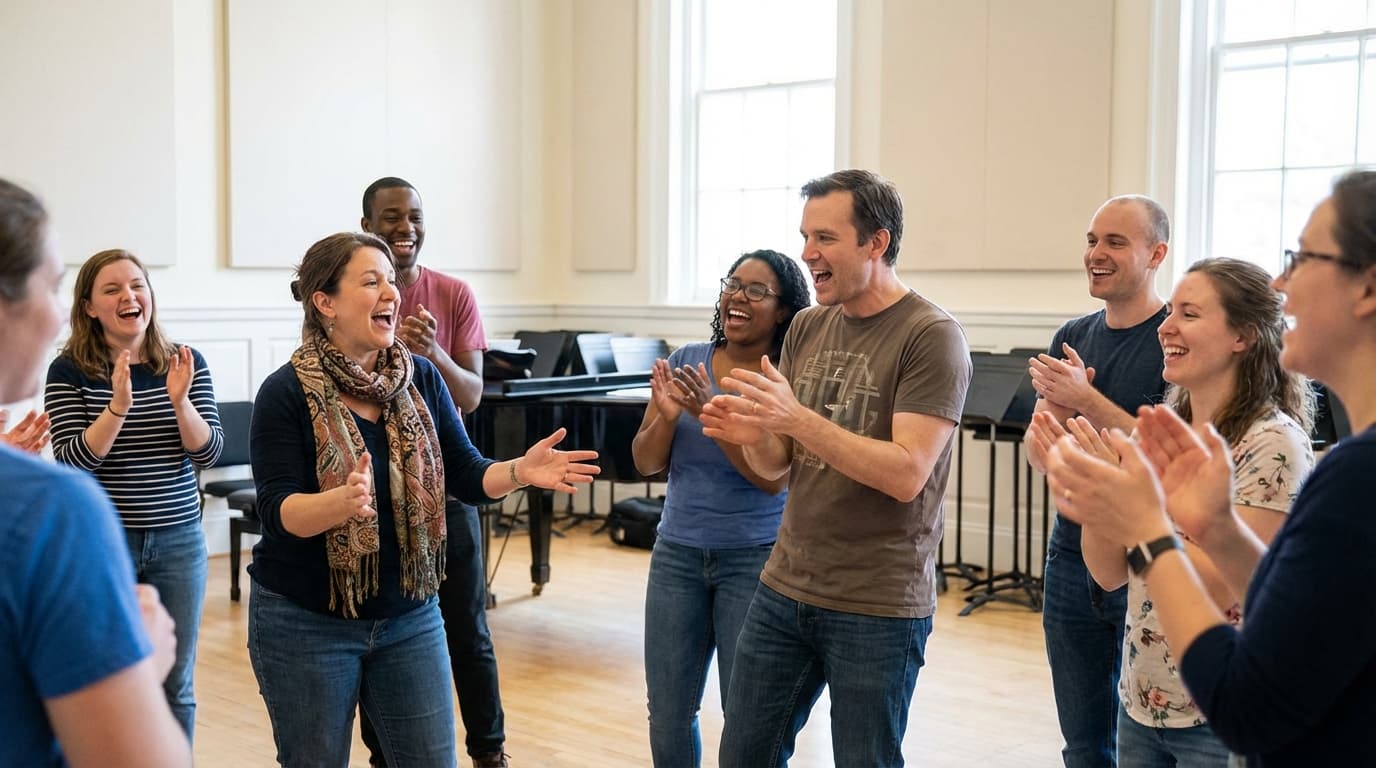
Ces exercices renforcent la cohésion de l'ensemble, entraînent l'écoute et apportent de l'énergie dans la pièce. Ce sont aussi ceux dont les chanteurs ont tendance à se souvenir et à demander. Ne sous-estimez pas le plaisir comme outil de répétition.
Canons et rondes
Une ronde comme "Frère Jacques" ou "Au clair de la lune" divisée en deux ou trois groupes est l'un des plus anciens outils d'échauffement de groupe, et ce pour une bonne raison. Elle exige des chanteurs qu'ils tiennent leur propre ligne tout en en entendant une différente à côté d'eux, ce qui est exactement la compétence d'écoute nécessaire pour le chant choral. Commencez à l'unisson pour apprendre la mélodie, puis divisez en groupes et superposez les parties.
Appel et réponse
Le chef (ou un chanteur) chante ou tape une courte phrase, et la chorale la répète. Variez la hauteur, le rythme ou la dynamique à chaque appel. C'est énormément polyvalent : vous pouvez l'utiliser pour introduire des idées mélodiques du répertoire de répétition, travailler sur des intervalles spécifiques, ou simplement détendre l'atmosphère. Cela développe l'attention et la réactivité du groupe, ce qui est le fondement de l'écoute d'ensemble.
Frappes rythmiques
Frappez un motif rythmique et demandez à la chorale de le répéter. Augmentez la complexité progressivement : commencez par des rythmes simples et réguliers, ajoutez de la syncope, puis essayez des combinaisons polyrythmiques réparties entre les sections. Cela travaille la précision rythmique et l'ensemble du groupe sans impliquer la voix du tout, ce qui est utile avant d'aborder un répertoire rythmiquement complexe.
Chant en écho
Similaire à l'appel et réponse, mais le chef chante une phrase mélodique avec un caractère spécifique (lyrique, staccato ou dramatique) et la chorale la répète en essayant de correspondre non seulement aux hauteurs mais aussi au style et à l'expression. C'est un moyen rapide de faire sortir les chanteurs de leur tête et de les amener à un chant réactif et expressif sans en faire toute une histoire.
Le jeu des noms
Faites le tour du groupe : chaque chanteur chante son propre nom sur une hauteur de son choix, et la chorale le répète. C'est particulièrement bon pour les nouveaux groupes ou au début d'une saison. Cela brise la glace, fait entendre toutes les voix dans la pièce, et a l'avantage supplémentaire d'aider tout le monde à apprendre les noms des autres. Gardez un rythme léger et rapide.
Paysages sonores
Donnez à la chorale un concept ("une tempête qui approche", "un marché animé" ou "une forêt profonde la nuit") et invitez-les à improviser des sons en utilisant leurs voix, leurs lèvres, leur souffle et leurs mains. Aucune hauteur ou mot spécifique n'est requis. Les paysages sonores libèrent les chanteurs de la conscience de soi de la performance et exploitent la créativité et le jeu. Les résultats sont souvent étonnamment musicaux, et le groupe aborde le répertoire réel en se sentant détendu et imaginatif.
6. Comment structurer une routine d'échauffement
Un bon échauffement a un arc logique. Vous passez du corps au souffle à la voix, allant du général au spécifique et de la faible énergie à l'engagement. Voici un modèle de 10 à 15 minutes éprouvé :
| Temps | Phase | Exemples d'exercices |
|---|---|---|
| 0–2 min | Libération physique | Roulements de cou, haussements d'épaules, rebondissements doux |
| 2–4 min | Activation du souffle | Respiration diaphragmatique, impulsions staccato, trilles labiales |
| 4–8 min | Échauffement vocal | Fredonnement, sirènes, gammes de cinq notes, formes de voyelles |
| 8–12 min | Focus technique | Arpèges, contrastes dynamiques, ou intervalles spécifiques au répertoire |
| 12–15 min | Ensemble & énergie | Une ronde, appel et réponse, ou paysage sonore |
Vous n'avez pas à suivre cela rigidement. Si votre groupe arrive plein d'énergie, sautez les rebondissements et passez directement à la respiration. S'ils sont fatigués, passez plus de temps sur les exercices de groupe amusants et moins sur le travail technique. Le modèle est un cadre, pas une règle.
7. Conseils pour les chefs de chœur
- Adaptez-vous au niveau et à l'âge de votre groupe. Une chorale communautaire d'adultes ayant des emplois de jour a besoin d'échauffements différents d'une chorale de jeunes sortant directement de l'école. Faites attention à l'endroit où la tension et l'énergie se situent réellement dans votre groupe.
- Connectez l'échauffement au répertoire. Si vous répétez une pièce avec de grands sauts, incluez des sauts d'intervalle dans l'échauffement. S'il y a un passage exigeant avec beaucoup de texte, ajoutez un virelangue. Les meilleurs échauffements servent aussi de préparation technique.
- Ne dépassez pas le haut de l'étendue. Les échauffements doivent se terminer avant que quiconque ne force. Le but est d'amener la voix à son état optimal, pas de tester ses limites. Si les gammes deviennent tendues, arrêtez et redescendez.
- Maintenez une rotation. Faire les mêmes cinq exercices à chaque répétition fonctionne bien, mais la variété maintient les chanteurs engagés et garantit que vous développez différentes compétences au fil du temps. Gardez une liste de vos exercices préférés et faites-les tourner délibérément.
- Modélisez ce que vous voulez. Lorsque vous démontrez un exercice, votre voix, votre posture et votre énergie établissent la norme. Les chanteurs correspondront à ce qu'ils voient et entendent. Si vous fredonnez avec un son détendu et vers l'avant, ils le feront aussi.
- Commencez à l'heure. Les échauffements apprennent aux chanteurs que la répétition a commencé. Commencer rapidement, même si quelques personnes arrivent encore, établit la culture du groupe. Les retardataires s'adapteront s'ils savent que l'échauffement a lieu quoi qu'il arrive.
- Observez et écoutez, ne vous contentez pas de diriger. Utilisez l'échauffement comme un outil de diagnostic. Les basses produisent-elles un son mince aujourd'hui ? La section soprano pousse-t-elle au-dessus de la rupture ? Repérer ces choses dans les cinq premières minutes signifie que vous pouvez adapter le plan de répétition avant que les problèmes ne deviennent des habitudes.
Conclusion
Le meilleur échauffement de chorale est celui que vous faites réellement, de manière cohérente, à chaque répétition. Il n'a pas besoin d'être compliqué. Même dix minutes de libération physique intentionnelle, de respiration et de travail vocal transformeront la qualité de la répétition qui suit, et vos chanteurs sentiront la différence immédiatement.
Constituez une bibliothèque d'exercices auxquels vous faites confiance, faites-les tourner pour garder les choses fraîches, et connectez toujours l'échauffement à ce sur quoi vous travaillez ce jour-là. Au fil du temps, l'échauffement devient une partie de la culture de votre chorale : le rituel qui signale "nous sommes là, nous sommes ensemble, faisons de la musique".
Si vous souhaitez partager des séquences d'échauffement avec vos chanteurs afin qu'ils puissent s'entraîner entre les répétitions, jetez un œil aux listes de pratique de ChoirMate, un moyen simple de maintenir tout le monde aligné en dehors de la salle de répétition.