

30+ Choir Warm-Ups: The Complete Guide for Choir Directors
30+ choir warm-up exercises for every rehearsal. Physical warm-ups, breathing exercises, vocal techniques, and fun group activities. A complete guide from the team behind ChoirMate.
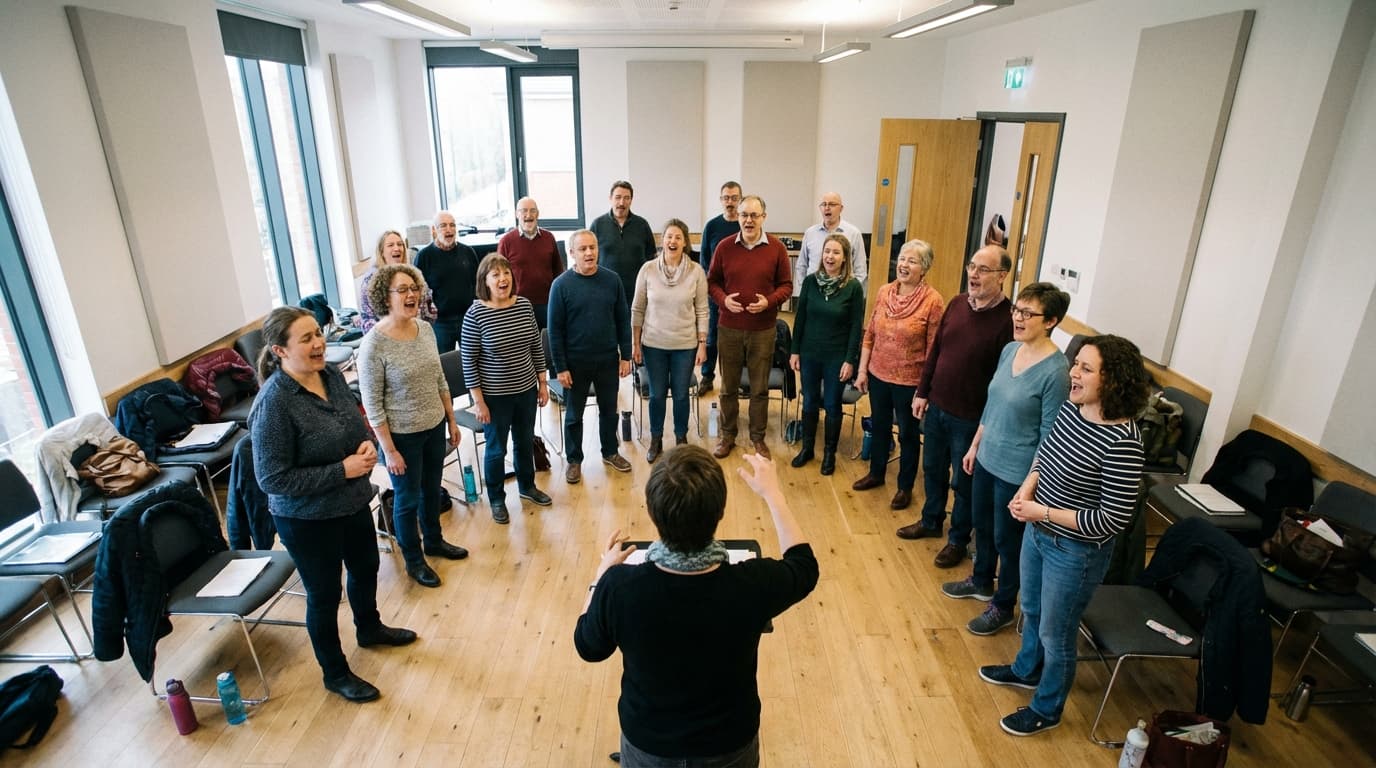
The best choir warm-ups combine physical stretches, breathing exercises, and vocal techniques to prepare singers for rehearsal. A 10-15 minute routine typically starts with body relaxation (neck rolls, shoulder shrugs), moves to breath support (diaphragmatic breathing, lip trills), and finishes with vocal exercises (scales, arpeggios, rounds). This guide covers 30+ exercises used by choir directors worldwide.
Every experienced choir director knows the difference between a rehearsal that starts cold and one that starts with a proper warm-up. In the first case, you spend the first twenty minutes coaxing sound out of a room full of tense bodies and sleepy voices. In the second, you hit the ground running: the group is present, the sound is centred, and everyone feels like a choir rather than a collection of individuals.
Warm-ups aren't just about protecting voices from strain (though that matters too). They signal the start of rehearsal, build group cohesion, establish the ensemble sound, and give you a few minutes to assess where the group is today, whether they're energised or tired, focused or scattered. A good warm-up routine is one of the most valuable tools in a director's kit.
In this guide, I've pulled together 30+ exercises across five categories: physical, breathing, beginner vocal, advanced vocal, and group activities. Each one is practical and tested in real rehearsals. If you use ChoirMate to manage your rehearsals, you can save your favourite warm-up sequences as practice lists so your singers can revisit them between sessions too.
1. Physical Warm-Ups
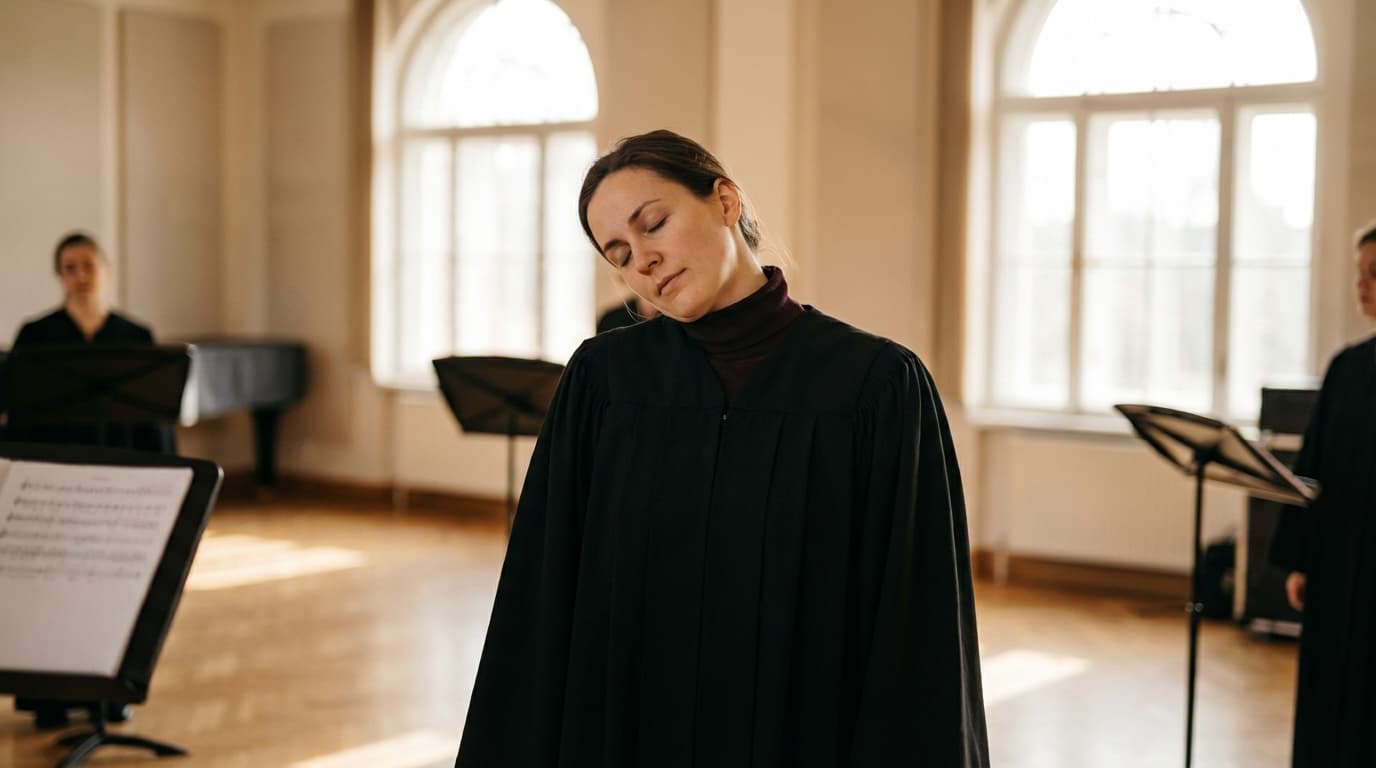
Singing is a full-body activity. Tension in the neck, shoulders, or jaw will show up directly in your sound. Before you make a single musical sound, get the body loose and the posture right.
Neck Rolls
Drop the chin to the chest slowly, then roll the head to one side, back up through centre, and to the other side. Avoid rolling the head fully back. Keep it in a gentle semicircle. Two or three slow rolls in each direction is enough to release tension in the neck muscles that directly affect the larynx.
Shoulder Shrugs and Rolls
Lift both shoulders up toward the ears as you inhale, hold for a beat, then drop them completely on the exhale. Follow this with backward shoulder circles, bringing the shoulders up, back, down, and forward in a slow rotation. This opens the chest and releases the tension that singers often hold across the upper back.
Jaw Stretches
Open the mouth as wide as comfortable and hold for three seconds, then release. Follow with gentle side-to-side movements of the jaw. Many singers carry a surprising amount of tension in the jaw and masseter muscles. Releasing this before singing helps the vowels open up and the tone become more resonant.
Ribcage Stretches
Stand with feet shoulder-width apart, raise both arms overhead, and lean slowly to one side, stretching through the ribcage. Hold for a few seconds, return to centre, and repeat on the other side. Singers need flexible intercostal muscles to expand the lungs fully, and this stretch gets them ready.
Posture Alignment
Ask singers to stand with feet hip-width apart, knees soft (not locked), spine tall, and shoulders relaxed and slightly back. The crown of the head should feel as if it's being gently lifted toward the ceiling. Have them rock forward onto the balls of the feet and back to the heels a couple of times to find a balanced, grounded position. Good posture isn't rigid. It's energised and free.
Gentle Bouncing
Simply bounce lightly on the balls of the feet for 20–30 seconds, letting the body be loose. This is especially useful at the start of a rehearsal when singers have just come in from outside or have been sitting all day. It shakes out residual tension and brings a sense of physical play into the room, setting the right mood for everything that follows.
2. Breathing Exercises
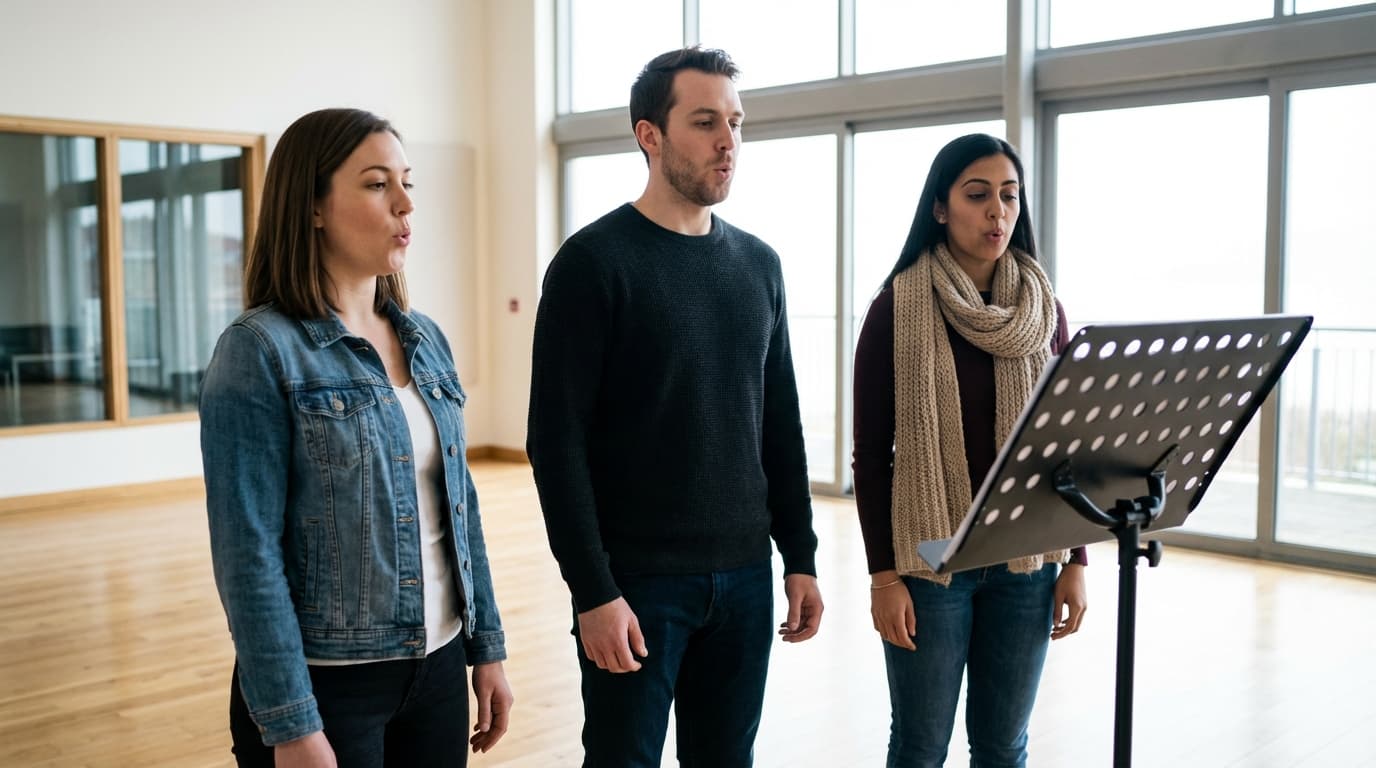
The breath is the engine of singing. These exercises develop diaphragmatic control, breath capacity, and the kind of supported, steady airflow that good choral tone depends on.
Diaphragmatic Breathing
Ask singers to place one hand on the chest and one on the belly. Inhale slowly through the nose for four counts, aiming to expand the belly (not the chest) outward. Exhale for four counts. The goal is to feel the lower hand move more than the upper one. Once the group has the sensation, try breathing in for four and out for eight, establishing the control they'll need for long phrases.
The Hissing Exercise
Take a full breath, then exhale on a sustained "sss" sound. The goal is to make the hiss as even and controlled as possible for as long as possible, rather than expelling all the air at once. This builds awareness of breath management and helps singers understand what "controlled support" feels like. Aim for 10–15 seconds to start, working toward 20+.
Staccato Breathing
Take a breath, then exhale in short, sharp bursts on "sh" or "ts", eight quick pulses per breath. This activates the diaphragm in a direct, physical way and helps singers feel the core engagement needed for supported singing. It also wakes the group up fast, which makes it a great opener when energy is low.
Breath Control Counting
Inhale for four counts, then exhale while counting aloud as slowly as possible. The goal is to see who can reach the highest number before running out of breath. Turning this into a friendly competition gives singers immediate feedback on their breath capacity and teaches them to pace airflow across a long phrase.
Lip Trills
Blow air through loosely closed lips so they vibrate in a trill (like a motorboat). Sustain the trill on a pitch, then slide up and down. Lip trills are brilliant because they relax the lips, engage the breath, and gently engage the vocal folds, all at once. If singers struggle, have them lightly press the cheeks inward with their fingertips.
Slow Exhale with Resistance
Inhale fully, then exhale through a small "o" shape in the lips, as if blowing through a thin straw. The resistance builds back pressure and trains the singer to support the air column rather than let it collapse. This is also a well-known vocal therapy technique for warming up without putting direct strain on the vocal folds.
3. Vocal Warm-Ups for Beginners
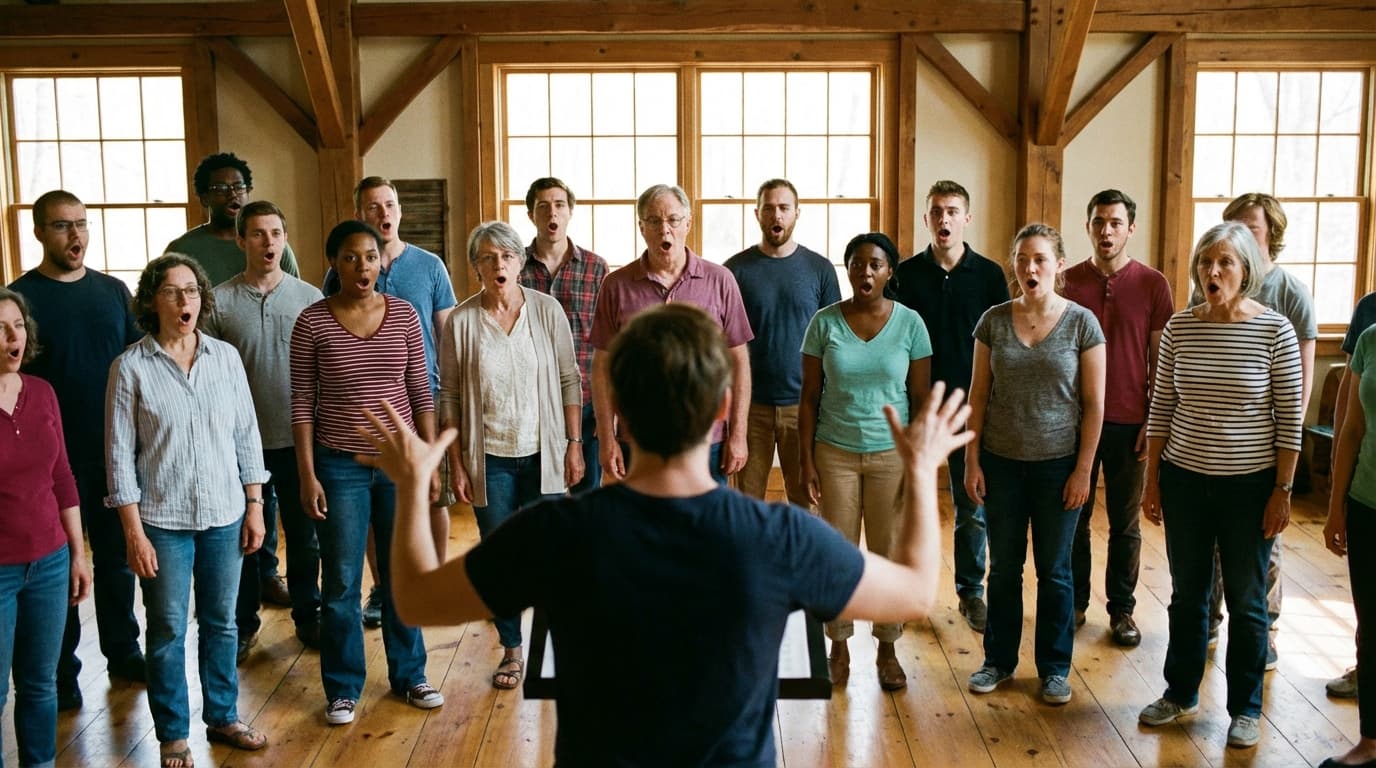
These exercises are accessible to singers at any level but are especially good for community choirs, youth choirs, or anyone new to structured warm-ups. They introduce core concepts like resonance, range, and vowel shaping, without overwhelming singers with technical demands.
Humming
Start on a comfortable middle pitch and hum with lips gently closed, feeling the vibration in the lips, cheeks, and nose. Slide slowly up a few steps and back down. Humming is one of the gentlest ways to engage the voice: it places the tone forward, warms the vocal folds gradually, and gives singers an immediate sense of resonance without any vowel shaping pressure.
Sirens
On a neutral "ng" or "wee" sound, slide continuously from the bottom of the voice to the top and back down, like a siren. The goal is a smooth glide with no breaks. Sirens are excellent for bridging the register break between chest and head voice, encouraging the voice to blend across its full range rather than switching abruptly.
Five-Note Scales
Sing "do-re-mi-fa-sol-fa-mi-re-do" on a vowel sound (try "ah" or "oh"), moving up by half-steps each repetition. Start low enough that everyone is comfortable, and continue only until the voice begins to feel strained. This is one of the most efficient vocal exercises because it covers range, vowel uniformity, and pitch accuracy all at once.
Vowel Shapes
Sing a sustained note on each of the five pure vowels in sequence: "ah – eh – ee – oh – oo." Focus on keeping the jaw released on "ah," avoiding a spread sound on "ee," and keeping "oo" forward rather than swallowed. Consistent vowel shapes are one of the biggest factors in a unified choral sound, so spending time on this is always worthwhile.
Octave Slides
Starting on a low pitch, sing a sustained vowel and slide smoothly up an octave, hold briefly at the top, then slide back down. Encourage singers to keep the jaw relaxed at the top and to resist the instinct to push harder as the pitch rises. This builds range awareness and reinforces the idea that high notes require less tension, not more.
4. Advanced Vocal Warm-Ups
For choirs with more experience, these exercises sharpen technique, extend range, build dynamic control, and develop the kind of vocal agility needed for demanding repertoire.
Arpeggios
Sing a major arpeggio (root, third, fifth, octave, fifth, third, root) on a single vowel, stepping up by semitones with each repetition. Arpeggios demand more interval accuracy than scales and challenge singers to maintain consistent tone colour across a wider range. Try them on different vowels to expose where the voice changes character.
Tongue Twisters
Classics like "red lorry, yellow lorry," "unique New York," or "she sells seashells" sung on repeated notes or a simple melody sharpen articulation and wake up the tongue, lips, and palate. For choral use, tongue twisters are especially useful before repertoire with demanding text: they get the articulators firing accurately at tempo and tend to generate a bit of laughter, which relaxes the group.
Dynamic Contrasts
Sustain a pitch or sing a phrase first at pianissimo, then mezzo forte, then fortissimo, and back down again. The goal isn't just to get louder, but to maintain consistent tone quality and resonance across the dynamic range. This is excellent preparation before rehearsing any repertoire with significant dynamic range, and it trains the group to think about support and intensity separately from volume.
Interval Jumps
Sing pairs of notes with increasing intervals (a third, then a fifth, then an octave) on a "ya" or "yo" syllable. Jumping intervals cleanly requires the voice to shift support and resonance quickly. This is one of the best exercises for training the body to prepare for a note before it arrives, a habit that improves pitch accuracy across the board.
Chromatic Runs
Starting on a comfortable pitch, sing up a chromatic scale (every semitone) for an octave, then back down, on a neutral syllable like "la" or "na." This develops flexibility, intonation precision across half-steps, and evenness of tone. It's also a good diagnostic: if the choir struggles with chromatic tuning in the warm-up, you know to pay attention to that in the rehearsal.
Messa di Voce
Sustain a single pitch, starting at the softest possible volume, growing to the loudest, and then fading back to soft, all in one breath, without breaking the tone. The messa di voce (Italian for "placing of the voice") is one of the oldest and most demanding vocal exercises in classical training. For choirs, doing it together builds extraordinary control over breath, support, and dynamic nuance. Even a simplified version, just a crescendo and decrescendo, is excellent.
5. Fun Group Warm-Ups
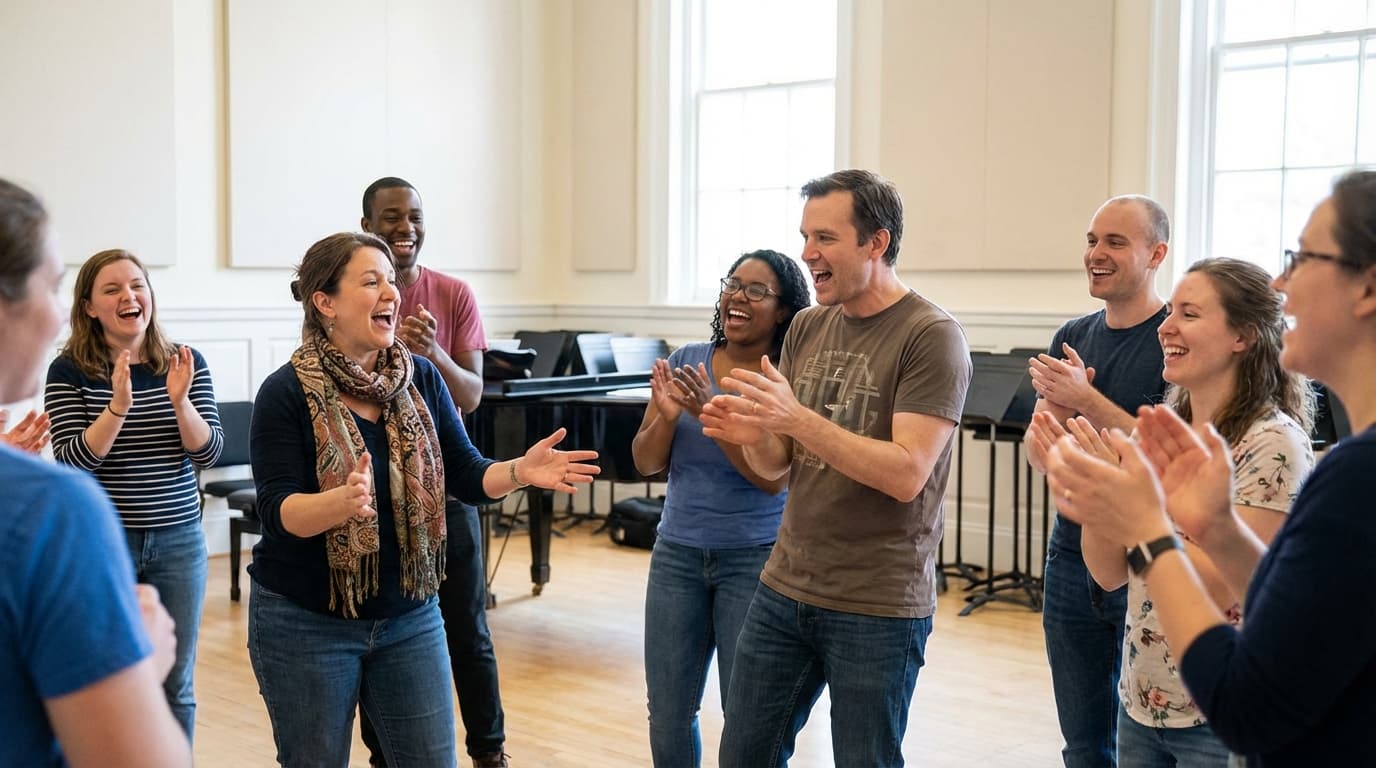
These exercises build ensemble cohesion, train listening, and bring energy into the room. They're also the ones singers tend to remember and ask for. Don't underestimate fun as a rehearsal tool.
Rounds and Canons
A round like "Row, Row, Row Your Boat" or "Frère Jacques" split into two or three groups is one of the oldest group warm-up tools for good reason. It requires singers to hold their own line while hearing a different one next to them, which is exactly the listening skill needed for choral singing. Start in unison to learn the tune, then split into groups and layer in the parts.
Call and Response
The director (or a singer) sings or claps a short phrase, and the choir echoes it back. Vary the pitch, rhythm, or dynamic with each call. This is enormously versatile: you can use it to introduce melodic ideas from the rehearsal repertoire, work on specific intervals, or just loosen things up. It builds attention and group responsiveness, which is the foundation of ensemble listening.
Rhythm Clapping
Clap a rhythmic pattern and have the choir repeat it. Build complexity gradually: start with simple even rhythms, add syncopation, then try polyrhythmic combinations split across sections. This works on rhythmic precision and group ensemble without involving the voice at all, which is useful before tackling rhythmically complex repertoire.
Echo Singing
Similar to call and response, but the director sings a melodic phrase with a specific character (lyrical, staccato, or dramatic) and the choir echoes it back trying to match not just the pitches but the style and expression. This is a quick way to get singers out of their heads and into responsive, expressive singing without making a big deal of it.
The Name Game
Go around the group: each singer sings their own name on a pitch of their choosing, and the choir echoes it back. This is especially good for new groups or at the start of a season. It breaks the ice, gets every voice into the room, and has the added bonus of helping everyone learn each other's names. Keep it light and fast-paced.
Sound Landscapes
Give the choir a concept ("a storm approaching," "a busy market," or "a deep forest at night") and invite them to improvise sounds using their voices, lips, breath, and hands. No specific pitches or words required. Sound landscapes free singers from the self-consciousness of performing and tap into creativity and play. The results are often surprisingly musical, and the group arrives at the actual repertoire feeling loose and imaginative.
6. How to Structure a Warm-Up Routine
A good warm-up has a logical arc. You move from body to breath to voice, moving from the general to the specific and from low-energy to engaged. Here's a tried-and-tested 10–15 minute template:
| Time | Phase | Example exercises |
|---|---|---|
| 0–2 min | Physical release | Neck rolls, shoulder shrugs, gentle bouncing |
| 2–4 min | Breath activation | Diaphragmatic breathing, staccato pulses, lip trills |
| 4–8 min | Voice warm-up | Humming, sirens, five-note scales, vowel shapes |
| 8–12 min | Technical focus | Arpeggios, dynamic contrasts, or repertoire-specific intervals |
| 12–15 min | Ensemble & energy | A round, call and response, or sound landscape |
You don't have to follow this rigidly. If your group arrives buzzing with energy, skip the bouncing and go straight to breathing. If they're tired, spend more time on the fun group exercises and less on technical work. The template is a frame, not a rule.
7. Tips for Choir Directors

- Tailor to your group's level and age. A community choir of adults with day jobs needs different warm-ups than a youth choir coming straight from school. Pay attention to where tension and energy actually live in your group.
- Connect the warm-up to the repertoire. If you're rehearsing a piece with wide leaps, include interval jumps in the warm-up. If there's a demanding passage with lots of text, add a tongue twister. The best warm-ups double as technical preparation.
- Don't push past the top of the range. Warm-ups should end before anyone is straining. The goal is to bring the voice to its optimal state, not to test its limits. If the scales are getting tight, stop and come back down.
- Keep a rotation. Doing the same five exercises every rehearsal works fine, but variety keeps singers engaged and ensures you're developing different skills over time. Keep a list of your go-to exercises and rotate deliberately.
- Model what you want. When you demonstrate an exercise, your voice, posture, and energy set the standard. Singers will match what they see and hear. If you hum with a relaxed, forward sound, they will too.
- Start on time. Warm-ups train singers that rehearsal has begun. Starting promptly, even if a few people are still arriving, sets the culture of the group. Latecomers will adapt if they know the warm-up is happening regardless.
- Watch and listen, don't just lead. Use the warm-up as a diagnostic tool. Are the basses producing a thin sound today? Is the soprano section pushing above the break? Catching these things in the first five minutes means you can adapt the rehearsal plan before problems become habits.
Conclusion
The best choir warm-up is the one you actually do, consistently, every rehearsal. It doesn't need to be complicated. Even ten minutes of intentional physical release, breathing, and vocal work will transform the quality of the rehearsal that follows, and your singers will feel the difference immediately.
Build up a library of exercises you trust, rotate them to keep things fresh, and always connect the warm-up to what you're working on that day. Over time, the warm-up becomes part of the culture of your choir: the ritual that signals "we're here, we're together, let's make music."
If you want to share warm-up sequences with your singers so they can practice between rehearsals, take a look at ChoirMate's practice lists, a simple way to keep everyone aligned outside the rehearsal room.