

Choir community
How to Remember Names in Your Choir (and Make It Fun)
Learn how to remember names and faces in your choir with simple memory habits, low-pressure games, profile photos, and short practice rounds.
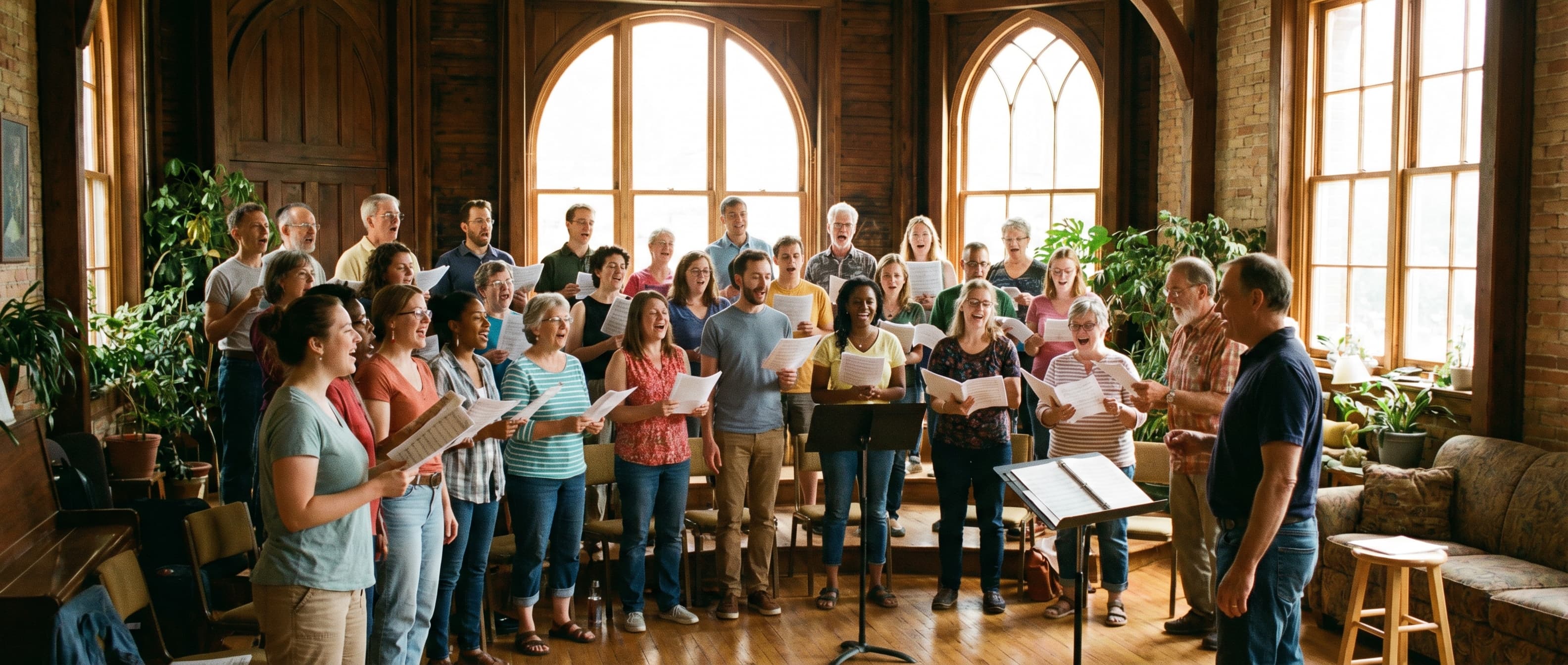
You know the feeling: the altos have become familiar faces, you have sung beside the same tenor for three months, and their name still disappears the moment you need it. Learning names in a choir can be surprisingly difficult. It can also be one of the simplest ways to make rehearsals feel warmer and more connected.
A choir brings people together around a shared task, but that does not automatically turn a room full of singers into a community. Names create small openings for conversation. They make it easier to welcome someone back, ask for help with a passage, or notice that a new member has arrived.
Why names matter in a choir
Singing is already a strong social activity. In one study of adult education groups, singing helped unfamiliar people feel connected more quickly than other group activities. Researchers have also observed increased social connectedness during longer choir sessions. Names give that early sense of togetherness somewhere to go after the song ends.
Knowing names lowers the small social cost of starting a conversation. Instead of “sorry, what was your name again?” you can say hello directly. New members can find the person who offered to share sheet music. Section leaders can give feedback without pointing across the room. Members who attend less often are easier to include when they return.
It is reasonable to think this supports cooperation, but it would be too strong to claim that memorizing names by itself makes a choir sing better. The immediate benefit is more human: people become easier to approach, and a large ensemble starts to feel smaller.
Further reading: the University of Oxford research on the social bonding effect of singing and research on social connectedness during choral singing.
Seven ways to remember names and faces
Names are difficult because they are arbitrary labels. A face gives your brain shapes, expressions, and context, while “Maria” does not explain why it belongs to this particular person. In memory studies, people have found names harder to recognize than faces. Forgetting is not a character flaw. It simply means you need a better way to practise the connection.
1. Repeat the name while you still have the person in front of you
A name often disappears because we were preparing our own introduction instead of listening to theirs. Give the name a moment of attention. Repeat it naturally in your reply, then use it once more before the conversation ends.
This is not about saying the name in every sentence. One or two thoughtful repetitions are enough to tell your brain that the information matters.
2. Connect the name with something real
Link the name to a detail you learned in conversation: Sam sings tenor and bikes to rehearsal, or Aisha joined before the spring concert. A meaningful connection is usually stronger than a clever rhyme based only on appearance.
Keep the association kind and private. The point is to give the name a place in your memory, not to label the person.
3. Learn one section at a time
Trying to learn forty names in one evening is a poor bargain. Start with the people around you, then add another voice section or rehearsal row. Small groups create repeated contact and make progress visible.
Conductors and committee members can help by mixing seating or conversation pairs occasionally, so people do not learn only their immediate neighbors.
4. Test yourself instead of rereading a list
Looking at a roster can feel productive even when the names are not sticking. A better test is retrieval: look at a face, cover the name, and try to produce it. Then check the answer immediately.
Research on face-name learning found that expanding retrieval practice performed better than simply relying on imagery. In practical terms, recall the name after a short delay, then return to it later with a slightly longer gap.
5. Use short, spaced practice rounds
Two minutes after several rehearsals usually beats one long study session. Revisit names the next day, the following week, and after a rehearsal break. The small effort of recalling a name is what strengthens it.
A useful personal target is three to five names at a time. Stop while it still feels light, then pick up the next small set later.
6. Choose name games that feel natural for adults
Name games for adults work best when they have a reason beyond performing for the room. Pair people for a two-minute conversation, then ask each person to introduce their partner by name and share one choir-related detail.
Another option is a section challenge: form small groups, give everyone ninety seconds to learn the names in the group, then change one or two members and repeat. Keep it cooperative. Nobody should be put on the spot for forgetting.
7. Make learning names welcoming, not compulsory
Ask how people pronounce their names and make a sincere second attempt when you get one wrong. If someone uses a shortened name or a different name from the membership list, follow their preference.
Photos can make practice much easier, but they should be used with consent and kept within the choir. Always offer another way to participate. The goal is recognition and belonging, never a public scorecard.
The memory suggestions above are informed by research comparing retrieval practice with other face-name learning techniques and research on the difference between remembering faces and remembering names.
A ten-minute name activity for your next rehearsal
You do not need a full social evening. Try this before warm-ups or during a planned break:
- Make groups of four or five, preferably with people who do not usually sit together.
- Give each person one minute to say their name, voice part, and one small choir-related detail.
- Ask the group to recall all the names together. Members can help each other.
- Move one person to a new group and repeat a shorter round.
- At the following rehearsal, invite everyone to greet one person from the activity by name.
The activity combines attention, a meaningful association, active recall, and a later repetition. More importantly, it gives people a reason to talk. Keep it playful and never turn forgotten names into a penalty.
Simple tools that make name practice easier
The best tool is the one your choir will actually use. Temporary name tags work well for new terms and project choirs. A printed seating chart can help conductors. A private member directory is useful between rehearsals, especially when it includes the name each person wants to be called and an up-to-date photo.
If you already keep member profiles digitally, you can turn them into a short name-and-photo quiz. Show one name with a few photos, let the singer choose, and give the answer immediately. Ten quick questions are enough for one round. This is a simple form of active recall, and it feels more like a game than studying a spreadsheet.

Correct and incorrect answers both become useful feedback.
ChoirMate members can find the activity at the bottom of their member list once the choir has enough profiles with photos. The Who's Who help article explains where to find it and how each round works.
Frequently asked questions
Why do I remember faces but forget names?
A face contains visual information, while a name is an arbitrary label that has to be attached to it. Memory research has found names harder to recognize than faces. That is normal, and it is why active recall and repeated meetings help.
What is the fastest way to remember people's names?
Pay attention during the introduction, repeat the name naturally, connect it to a real detail, and test yourself again after a short delay. A few brief recall attempts spread over several days are more useful than repeatedly reading a list.
What are good name games for an adult choir?
Use low-pressure pair introductions, small section challenges, or a private name-and-photo quiz. Keep rounds short and cooperative, and avoid asking one person to recall every name in front of the whole choir.
What if choir members do not want to use profile photos?
Respect that choice. Name tags, section maps, paired conversations, and introductions still work well. If you use a digital directory, explain who can see the photos and what they are used for.
How long does it take to learn everyone in a large choir?
There is no fixed deadline. Learn a few people at each rehearsal and keep revisiting earlier names. Consistent, friendly practice matters more than speed, especially when attendance changes from week to week.
Start with three names
You do not have to know the entire choir by next Tuesday. Pick three people, learn the names they want you to use, and greet them at the next rehearsal. Then add three more. That steady curiosity is what changes a collection of familiar faces into people you know.
Make the practice easy, private, and forgiving. The reward is not a perfect score. It is the moment when someone walks into rehearsal and you can welcome them by name.